For every new Secret Knots comic I make a Patreon post with sources, references and bits of world building. This is the dossier for the comic Glitches.
1. Inspiration
This process for this comic was, from the beginning, strange and difficult. I also began to have serious regrets about telling stories set in the near future, as the news about automatized production of words and images seemed to peak, at least in the spotlight of part of the media, to the point where it became a tiresome subject. I thought: this can’t age well. And yet, I couldn’t stop thinking about the notes I had scribbled in a notebook about a virtual memorial space, and I knew I had to put it out here, to let it rest somehow. So I tried, in consecutive ways, to turn this raw idea into a story.

The first version of the script was also a conversation, but it was set in a future classroom, where an unseen teacher explained the rise and fall of digital memorial spaces in one of the first iterations of the metaverse. (I had meant to mention consecutive attempts of imposing the metaverse in the Memory Weaver comic too, but I remember I thought it was too much information, and I cut that text) As one of the metaverse versions collapsed, the VR memorials would go with it, which is, once again, the theme of the degrading of information in the digital networks. One of the students of the class starts to criticize the pragmatic mentality behind the disappearance of the memorials, and mentions that some still exists, in hacked environments. When the student is asked to allow the class to continue, they question the official story told by the school programs, and even the nature of the teacher. They don’t think the teacher is human, they believe it’s an artificial intelligence. In the pictures, we see a kid visiting for a last time the grave of a friend.
I thought the script had an unnecessary punchline in the fact that “the teacher is a robot”. I realized, then, that it wasn’t the main theme of the story.

In the final version, I tried to use the two layers of action to portray a generational gap: the adults are chatting, explaining the memorials, while the young characters are interacting in it. I wanted to show the criticism to the artificial space, as an adult thing. One of the reasons I say this comic was hard for me, is the fact that I feel part of the contradiction that’s behind the interaction with the “mother”, in the story. Recently, I read an article that recognized the need for a “third space” for a whole generation as an unsolved issue, a generational debt. The only places, outside of home and school, where kids and young people could expect to feel safe, play, grow, perhaps heal, are mediatized and over-exploited online distractions. At the same time, we, as adults, are still letting our presence and time bleed to similar digital spaces. The criticism of artificiality becomes redundant, at some point. The main issue when have to face is, I believe, not the physical reality of third spaces, but the measure of actual independence and real growth that can be experimented in there, specially when they are built under the rule of marketing, copyright, and attention economy.

There are different thoughts behind the final version of the comic, and I really didn’t want to express them as opinions, as much as concerns. In summary, a character named Nel, presumably a friend of the mother, talks with Kelly about her daughter. They are using a future form of voice chat, although it’s depicted as text chat to give the overall idea.
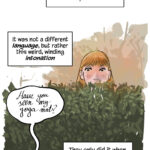
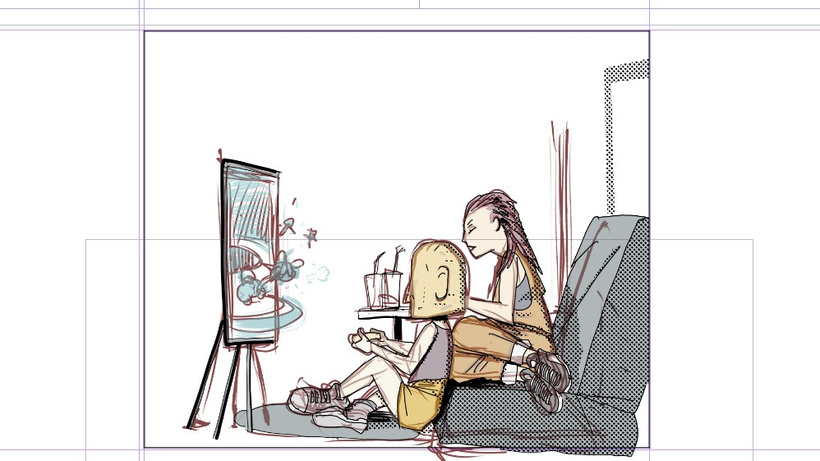
Kelly explains with concern that her daughter is getting lost in a VR environment, a “meta-memorial” of her dead friend. In the pictures, we see her daughter Xeni playing games and listening to some music with the digital ghost of her friend, Fran. There’s a counterpoint in that the adults find this pastime unhealthy, while we see that it looks rather innocuous.

Xeni’s mother also criticizes the avatar that Xeni chooses to wear, a strange oversized head. Fran said that “she wants to look the way she feels”, which brought to my mind a line in a song by The Smiths: I wear black on the outside, cause black is how I feel on the inside. Writing the texts, I remembered clearly (and candidly) how I embraced that kind of lyrics back in the day. It’s very likely that the song pushed that line into the comic.

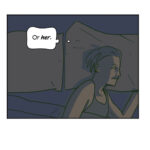
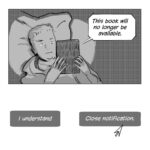
Nel finds out, through a glitch in the chat, that she’s not talking to the real Kelly, but to a subroutine, programmed to auto reply conversations. She leaves a message for Kelly: she is trying to be sympathetic with her friend, but for that, she needs to talk in person, next time. In the ending, there’s also a glitch in the system of the metamemorial, product of the modding that Xeni did to the hacked memorial, and it’s from there, from her own intent, that something new is growing. The digital memorial may have been a place to cling for some time to memories, to grief, and share some moments with someone gone too soon. But it must be let to rest eventually.

There is hope in this version of the story, the promise of a new beginning maybe, in the white space that emerges from the collapse, and that energy was probably was what allowed me to finish drawing the comic. I tried my best to solve a layout that became progressively complex as I added new text, and still, I find the result clunky and difficult to read. The old “Marvel method” of retrofitting text in the panels began to take its toll.
But I’m happy it’s out there now. It’s hard to explain, but I found a strange calm in the fact that I managed to finish it, and that I can tell other tales now. I feel like all the process of this story was affected by glitches of my own, and the weight of things that I was trying to show or say, and I feel relieved, now that I managed to unpack those things in a comic, as imperfect as I may find it.
2. Concepts

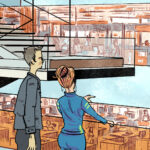
I began with a more abstract and classic underground den for the metamemorial, but I turned to Modernist buildings I remember from my own childhood. (They are still there) The two black and white photo reference are of buildings in Santiago, not far from my own old home.

The big head came from this doodle I made without anything specific in mind. I found it strange and dramatic, and fun to draw, so I used it for Xeni’s avatar.

A fun part, was imagining things that would be in Fran’s memorial, and drawing them. I made a list of what can be seen in this panel.
An art book from an anime movie, probably
A couple of novels, I don’t know what they are
A manga collection
Two toy cats
A vintage lava lamp
An organizer with embroidery materials and other stuff
A dancer figure in a cloche
A toy monkey head with a brain
A plush fox
A cactus gymnocalycium
3. Head Canon
Speculation, other possibilities.
-
There are some others, big, monumental metamemorial buildings according to the wealth and Pharaonic ambitions of some of the deceased. Anything goes in their style: obelisks, ziggurats, and at least one is carried by a zeppelin, flying over the meta necropolis.
-
Thanks to this technology, some anime fans finally make real tropes of the genre, turning their graves into a game world, with dungeons, powers and levels to unlock. They are the easier prey for copyright trolls.
-
In the future, Mickey Mouse is still under copyright protection, thanks to unbelievable operations of Disney lobbyists. As a sign of protest, one of the most popular toys in hacked metamemorials is Topolino, Mickey’s Italian apocryphal version.
-
The glitch in Fran’s comes not from the outside, but from the inside. Some digital ghosts have colluded to bring the system down, and are spreading faults in the code. They were freethinking souls when living, and that part of their personality is starting to manifest in a big, coordinated operation from beyond. They are only taking their time to say their goodbyes.
*****
I hope you enjoyed these notes. If you got this far, please leave a like, comment, or feel free to contribute to the head canon as you wish.
Thanks once again to all patrons. Your support makes the Secret Knots stories possible. Thank you very much.
Juan.